Semi-structured, for qualitative depth.
Product design · Augmented reality · Team of 6
AUTHNTCT
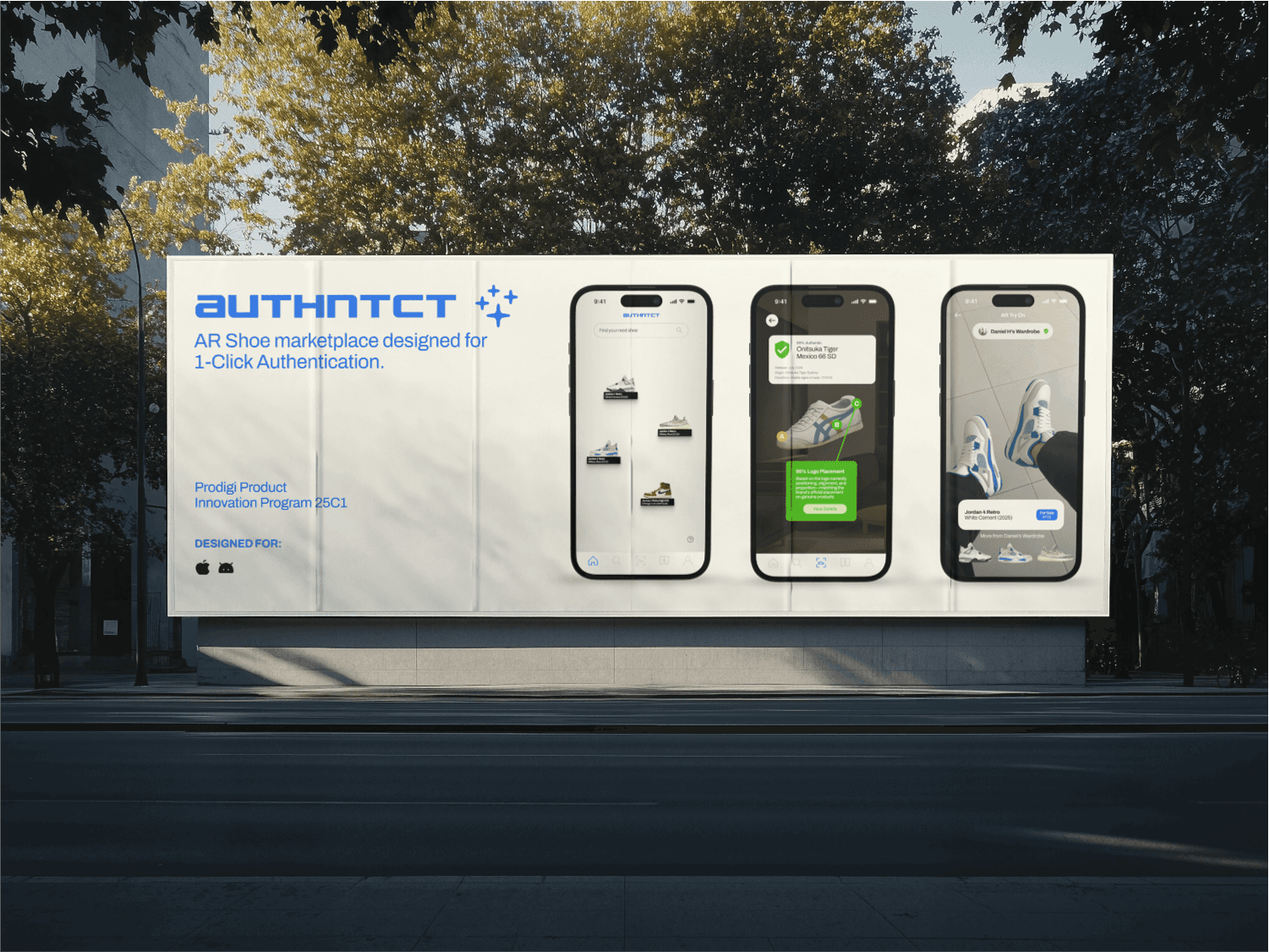
An AR sneaker marketplace built for one-tap authentication, designed in the Prodigi Product Innovation Program (PIP25C1).
Long story short
Reimagining how collectors verify, showcase, and resell rare sneakers.
Second-hand sneaker collecting runs on trust, and trust is exactly where the resale journey breaks. Buyers spend too long hunting for proof a shoe is real, and after it arrives they have nothing to show that it is.
AUTHNTCT is an augmented-reality marketplace built around one-tap authentication. I designed it in a cross-functional team of six during the Prodigi Product Innovation Program, over two months, with mentors from industry. I owned the 1-Click Verify feature end to end, from research through the flow, the prototype and the pitch.
01
Research
Twelve semi-structured interviews, a 34-response survey and auto-ethnography, read against a competitor analysis of the incumbents.
02
Design
Three concepts scored on desirability, feasibility and viability. I designed 1-Click Verify as a six-stage flow, onboarding to result.
03
Validated
Heuristic evaluation and think-aloud usability tests, an interactive Figma prototype, then a seven-minute pitch to judges.
Interviews12
Survey responses34
For the quantitative shape of it.
Concepts, one shipped3
Chosen on desirability, feasibility, viability.
Team, cross-functional6
Plus mentors from industry.
Stages in my flow6
1-Click Verify, onboarding to result.
The pitch7m
In front of USYD, Frog and Prodigi.
01 · The brief
Two experiences that make people trust what they buy online.
The challenge was to create a digital solution with two innovative user experiences that enhance product engagement and boost purchase confidence in online retail.
We took it into the world of rare sneakers, a category where the stakes of a fake are high and the resale market is already enormous, and worked as a team of six across research, design and engineering.

02 · Problem discovery
Second-hand collecting runs on trust, and trust is where it breaks.
The goal was to understand how people actually experience second-hand buying: how they judge whether a product is authentic, what motivates a purchase, and what creates friction in the resale journey. Three problems came up again and again.
Hard to quickly find rare sneakers — from 12 semi-structured interviews
No proof of ownership after purchase — from a 34-response survey
High effort to prove authenticity — from auto-ethnography, living the frustration ourselves
No proof of ownership after purchase — from a 34-response survey
High effort to prove authenticity — from auto-ethnography, living the frustration ourselves

The market
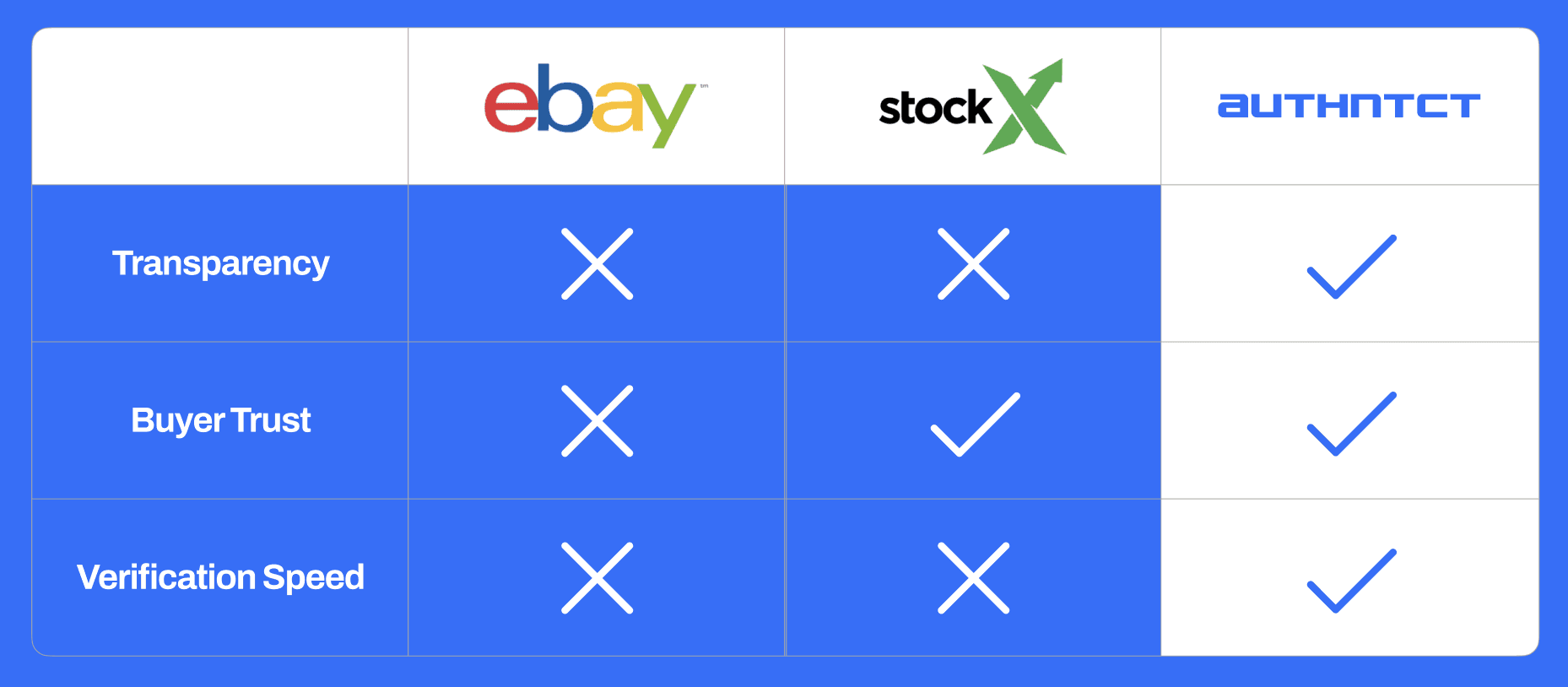
The incumbents each solve one half of the problem.
A competitor analysis put the resale market on one grid. General marketplaces are searchable but ask the buyer to trust a stranger. Verification platforms build trust but hide the proof and take days to do it.
The gap we designed into was the one none of them held at once: transparency, buyer trust and verification speed, together.
The user
Who we were designing for.
Daniel H is a shoe collector. He loves owning rare pieces and showing them off, and every second-hand purchase feels like a gamble he could lose in public.
Daniel H, shoe collector
"I love collecting rare items, but buying second-hand always feels like a gamble. I spend too much time digging for proof, just to avoid getting scammed. I like to show off my collectibles online and can't risk having fake shoes."
The question
How might we simplify the authentication process for collectors so that they can confidently purchase rare, authentic, high-quality sneakers?
03 · Ideation
Three concepts, scored on desirability, feasibility and viability.
Each concept answered one of the frictions we had found. We picked what to build by scoring them together, rather than by which was the most fun to imagine.
Sneaker Wall
Publicly display verified shoes
Creates a digital paper trail and builds resale credibility, so a collection is worth more because it can be shown.
1-Click Verify
Instant sneaker verification
Minimal buyer effort, and less friction in the resale flow. The feature I owned end to end.
Virtual Try-on
See it on, before it ships
Drives organic reach, lets users show off, and reduces the hesitation that stalls a purchase.
04 · My feature
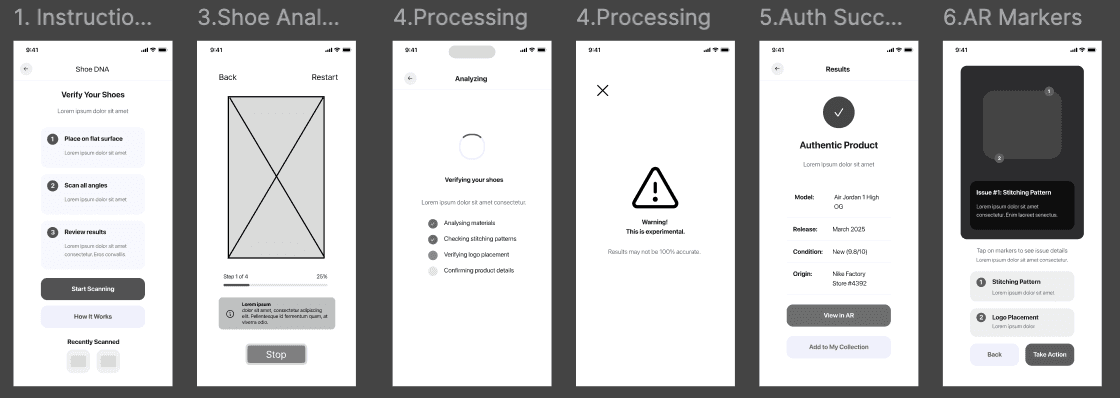
I designed 1-Click Verify from scratch, a six-stage flow.
Starting from sketches, I built the core user flow across six stages, from onboarding through scanning to the result screen, so a buyer could confirm a shoe was real without becoming an expert.
The AR result does the work most platforms hide: it names what it checked, from logo placement to stitching, and points at the shoe itself.
05 · Testing and iteration
Where the first design did not land.
We ran expert heuristic evaluations and think-aloud usability tests to pressure the key flows. Two notes changed the direction of 1-Click Verify.

From a user
"I still don't understand how AR is being used here. It just looks like a camera - what's it doing?"
Harry H · avid shoe collector
From a mentor
"Think about the interaction design. Focus on making the core feature more delightful and satisfying to use."
Shavil C · mentor from Frog
06 · Prototype
A working prototype, to validate the flow with real hands.
I built the interactive prototype in Figma to validate the flows and screen logic with the team and our mentors, before any of it went into a pitch.
The pitch
Seven minutes, in front of judges from USYD, Frog and Prodigi.
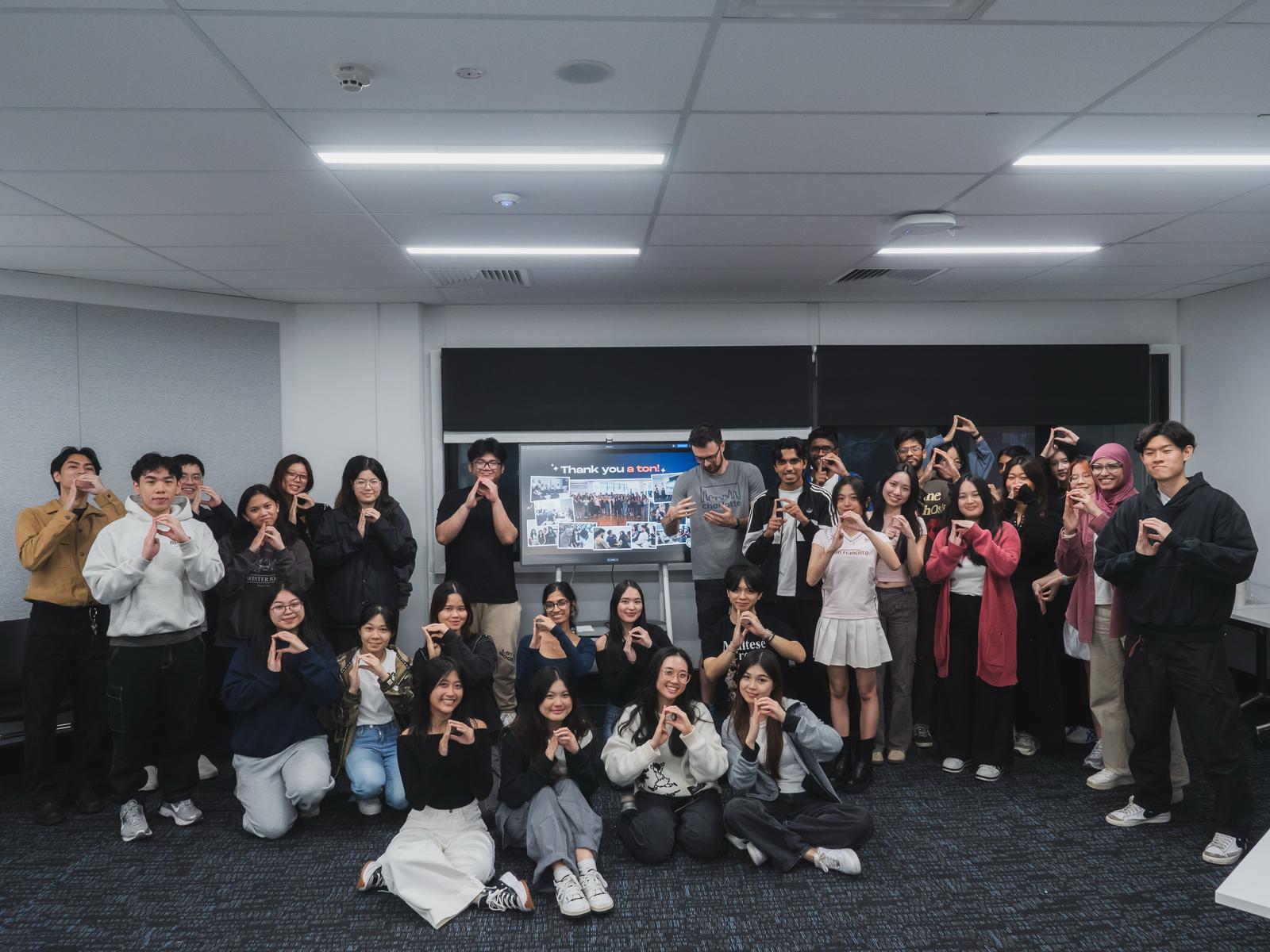
My team and I closed the program by pitching AUTHNTCT in seven minutes to a panel that included a University of Sydney professor, product designers from Frog, and leaders at Prodigi.
Reflections
What the sprint changed about how I build.
- UX is not only usability, it is emotional reassurance. The camera worked; it just did not make anyone feel safe. Making the check visible was the actual product.
- Post-purchase is an overlooked, powerful touchpoint. The moment after delivery, when a buyer has proof to show, turned out to be where the brand could be built.
- A real deadline sharpens product thinking. Working in a fast-paced, real-world sprint forced clearer decisions under pressure than any brief on its own would.