Of 50 survey participants, regularly.
UX/UI + Business · 2021
Foodpile
An app that designs out the human error in meal planning, so young adults stop overbuying and wasting food on the weekly shop.
Long story short
Households buy more than they need, then bin the difference. Foodpile plans the shop so they don't.
Foodpile was built for AIESEC's YLX pitch competition, a brief to help young adults cut household food waste. It pairs a pantry that tracks itself with shopping lists generated from what you already have and the recipes you choose, so you stop buying food you will not use.
It won the National Prize. This is the research, the product and the business case behind it. Foodpile was a team project; my role was the UX/UI and the business model.
01
Researched
A 50-person survey, interviews and focus groups to find where and why young adults overbuy.
02
Designed
A pantry that tracks passively, shopping lists generated from purchase history, and an impact scoreboard.
03
Pitched
A freemium model and financial case, presented to judges from Google, the UN and AIESEC.
Buy more than they need75%
Pantry items forgotten60%
Went unused, then thrown away.
Pitch outcome1st
AIESEC YLX National Prize.
Ideas generated40+
Narrowed to three product pillars.
Premium price$2.99
Per month, on a freemium model.
Year-one target1M
Downloads, the projection was built on.
The question
How might we support young adults to minimise their household food waste, so that we can help halve food waste by 2030?
01 · The problem
Australia throws out one bin of food in six, straight from the kitchen.
The client was AIESEC, the world's largest youth-run and youth-led organisation, connecting young people to business and empowering them to drive sustainable social impact. The brief: help young adults cut household food waste, and contribute to halving it by 2030.
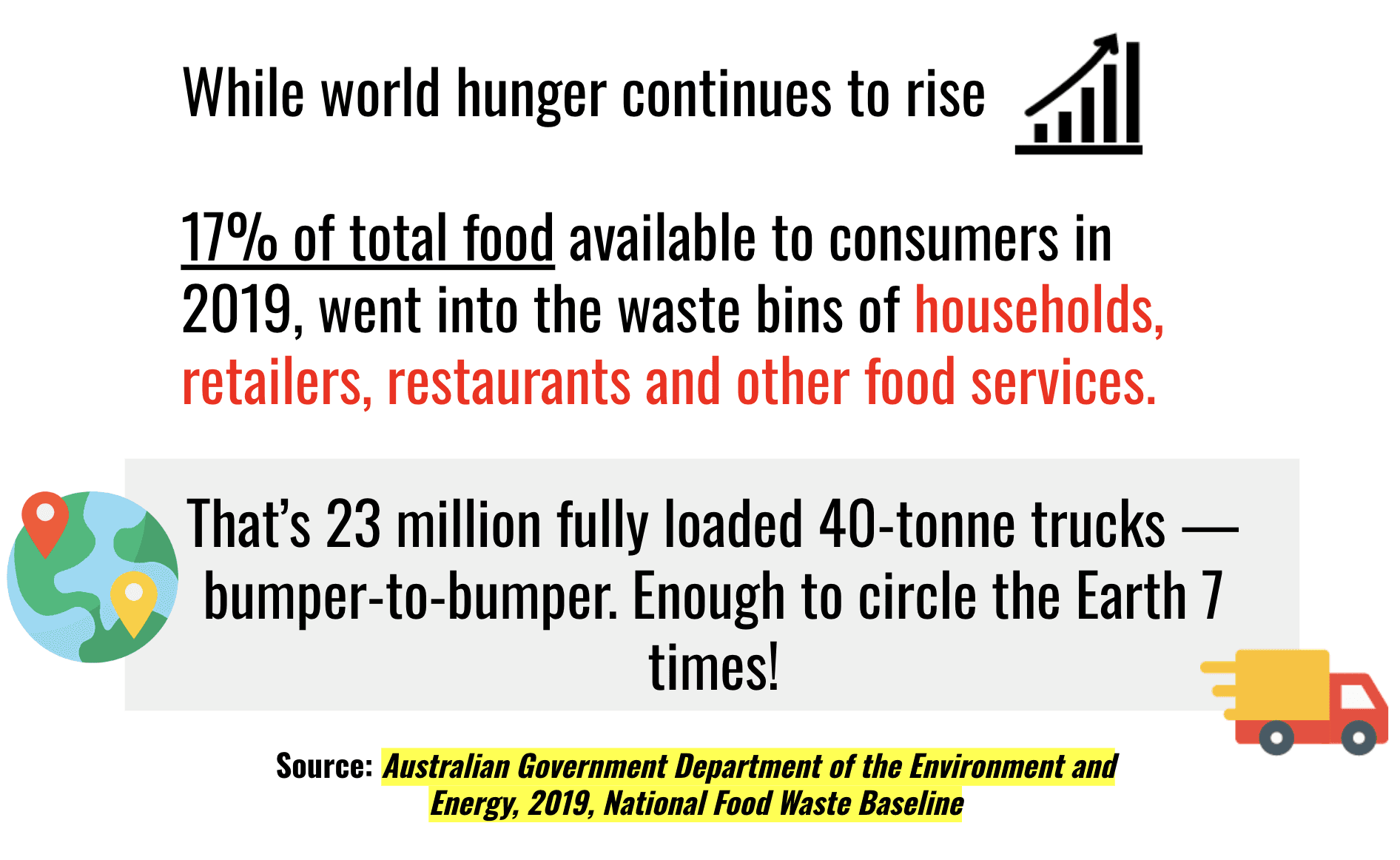
The scale is hard to picture. 17% of all food available to consumers in 2019 went into the bins of households, retailers and restaurants, enough loaded trucks to circle the Earth seven times. Households are the largest single share.
Source: Australian Government Department of the Environment and Energy, 2019 National Food Waste Baseline
02 · The user
One person to design for: busy, well-meaning, and out of time.
Alex Kinley, 22. A packed schedule leaves him no time to plan meals or keep his pantry in order, so he overbuys, forgets what he already has, and throws food out. He wants to waste less, spend less, and do something for the environment without it becoming a chore.

Goals and motivations
- Reduce food waste while saving money on groceries.
- Make grocery shopping and pantry management easier.
- Contribute to environmental sustainability in small, manageable ways.
Pain points
- Often buys more than he needs, leading to spoilage.
- Finds it hard to track pantry items and expiry dates.
- Has limited time for meal planning around a busy schedule.
03 · The research
Fifty surveys, interviews and focus groups pointed at one behaviour.
We surveyed 50 people, then ran interviews and focus groups to understand how young adults shop. 75% admitted they regularly buy more than they need. Nearly 60% said forgotten pantry items often went unused.
The problem was not willpower. It was visibility: people cannot buy well for a pantry they cannot see. That reframed the design from a meal planner into a way to make the pantry legible.
Methods: Surveys (n = 50), interviews, focus groups
Insight: Overbuying is the behaviour to design against
Insight: Overbuying is the behaviour to design against
04 · Ideation
Forty ideas, cut to the few that actually stop overbuying.
We generated more than 40 concepts, then kept only the ones that attacked overbuying directly rather than adding features around it.
The idea pool
NFC pantry tracker
AI shopping lists
Expiry reminders
Recipes from what you have
Leftovers marketplace
Clearance alerts
Meal-planning wizard
Impact tracker
Budget tracker
Family sharing
Leftovers recipes
Stock-level alerts
05 · The solution
Eliminate the human error in meal planning.
Minimise the time, money and effort spent on the shop. Foodpile does it three ways, shown here as the Figma prototype of the main user flow.
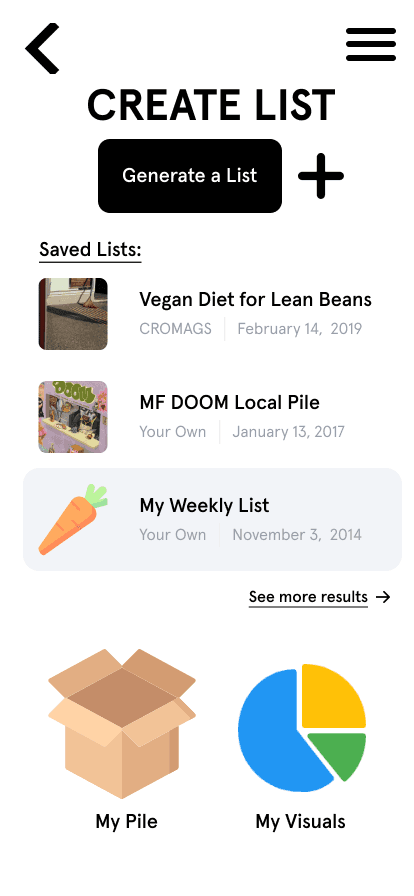
Generate the list
Shopping lists built from your purchase history and chosen recipes, so you buy for what you will actually cook.
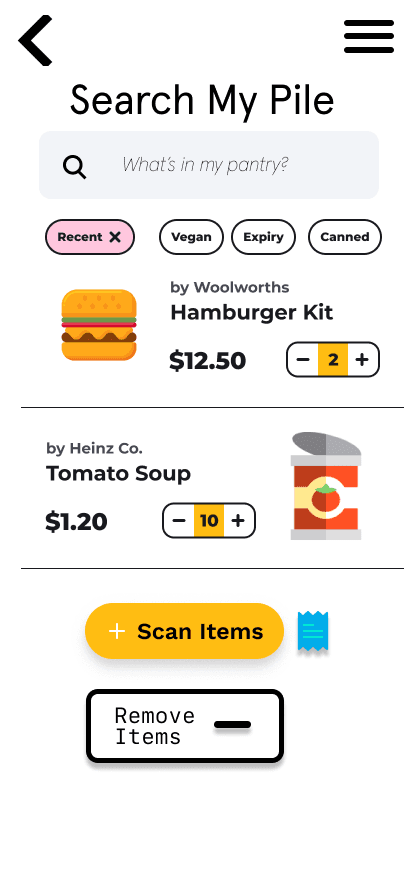
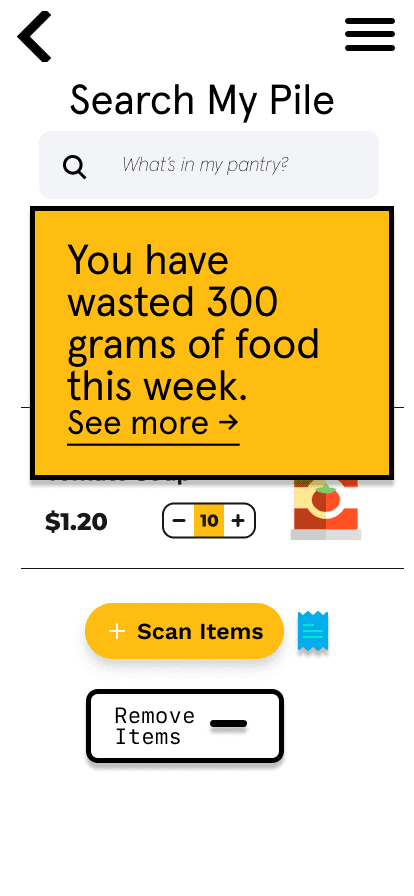
Track passively
An automated view of what is in your pantry, so you avoid overbuying without constant manual updates.
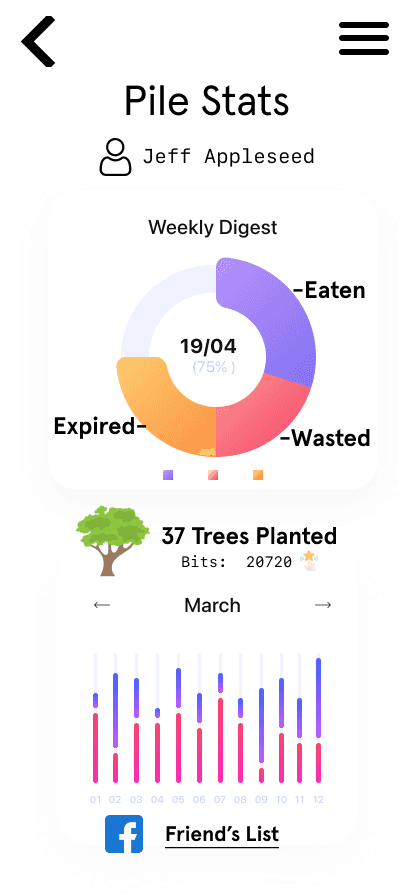
See the impact
Your environmental impact in usage stats and a competitive leaderboard against friends.
06 · The business model
Freemium, with a real reason to go premium.
Free to use, with a $2.99 per month tier that unlocks premium features, including a Marketplace for Leftovers. Revenue also comes from anonymised data insights and ads in the free version. That funds the recommendation algorithms, supermarket loyalty integrations and the interface.
Revenue in
- $2.99 per month premium, including the Marketplace for Leftovers.
- Selling anonymised data insights.
- Targeted ads in the free version.
Revenue out
- Product development on the recommendation algorithms and interface.
- Integration with supermarket loyalty programs.
- Marketing on Instagram and TikTok to reach young adults.
Market penetration
Advertise through national food-waste advocacy groups: Foodbank, SecondBite, OzHarvest, REAP.
Product development
Build a recommendation engine with ML for recipes and clearance items.
Market expansion
Partner with retailers such as Woolworths, using loyalty programs to send scanned items to the app.
07 · The projections
Modelled on a million downloads in year one.
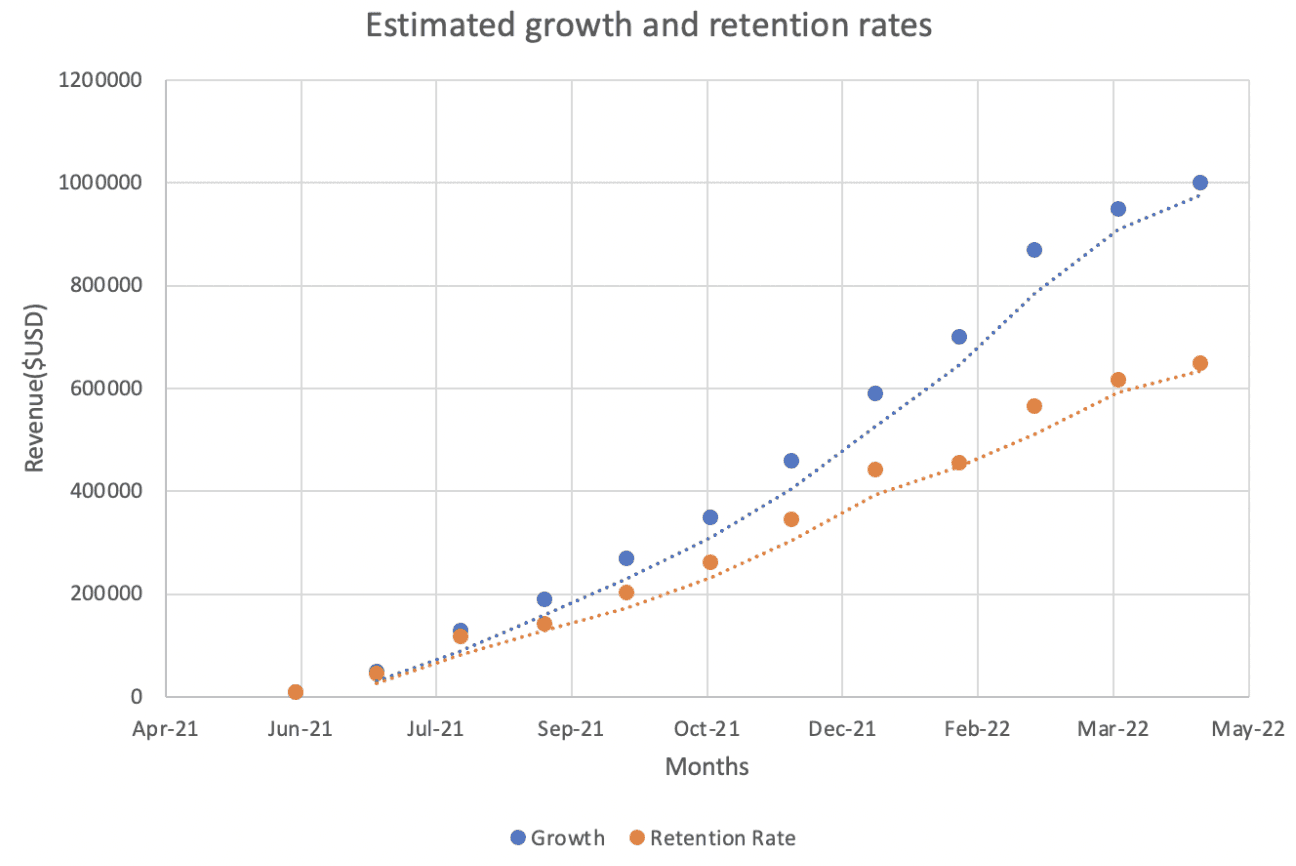
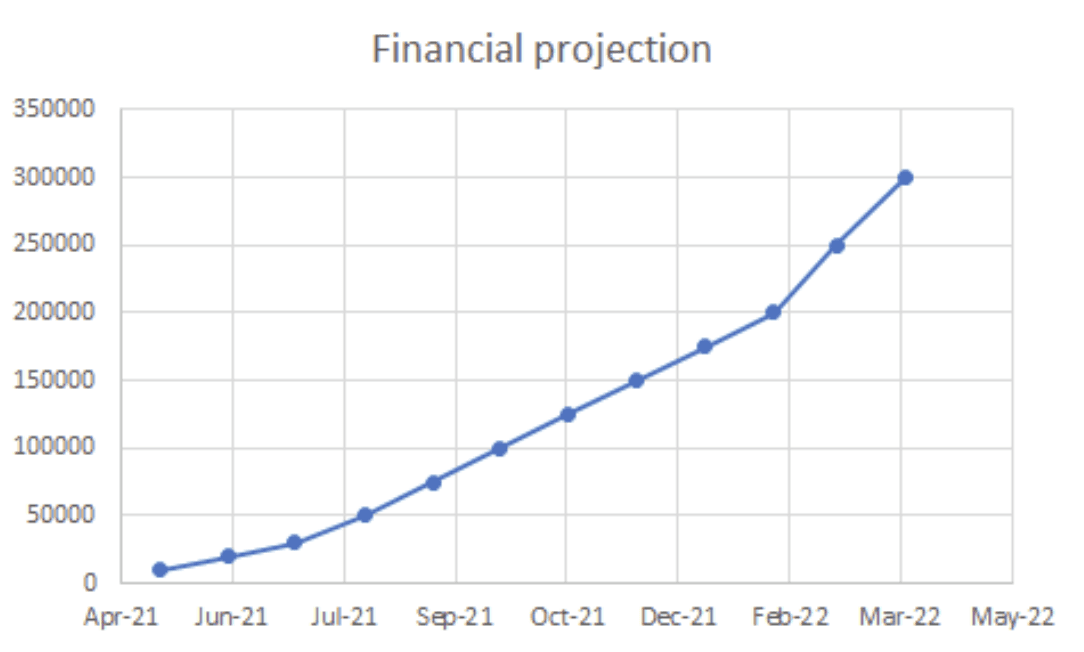
Growth and retention were modelled on high-performing apps in the category. The financial projection extrapolated from those retention rates, a known CPC and click rate of 0.02, and an assumption of ten ad impressions per active user per day.
08 · The ask
Asked for $10k. Offered three times that.
We sought $10,000 for 20% of the business. The Academy of Entrepreneurs, then the largest startup incubator in the southern hemisphere, offered $30,000 for 10% on the condition that we could show 100 active users.
What we asked
$10kFor 20%
What we were offered
$30kFor 10%, at 100 active users
09 · Outcome
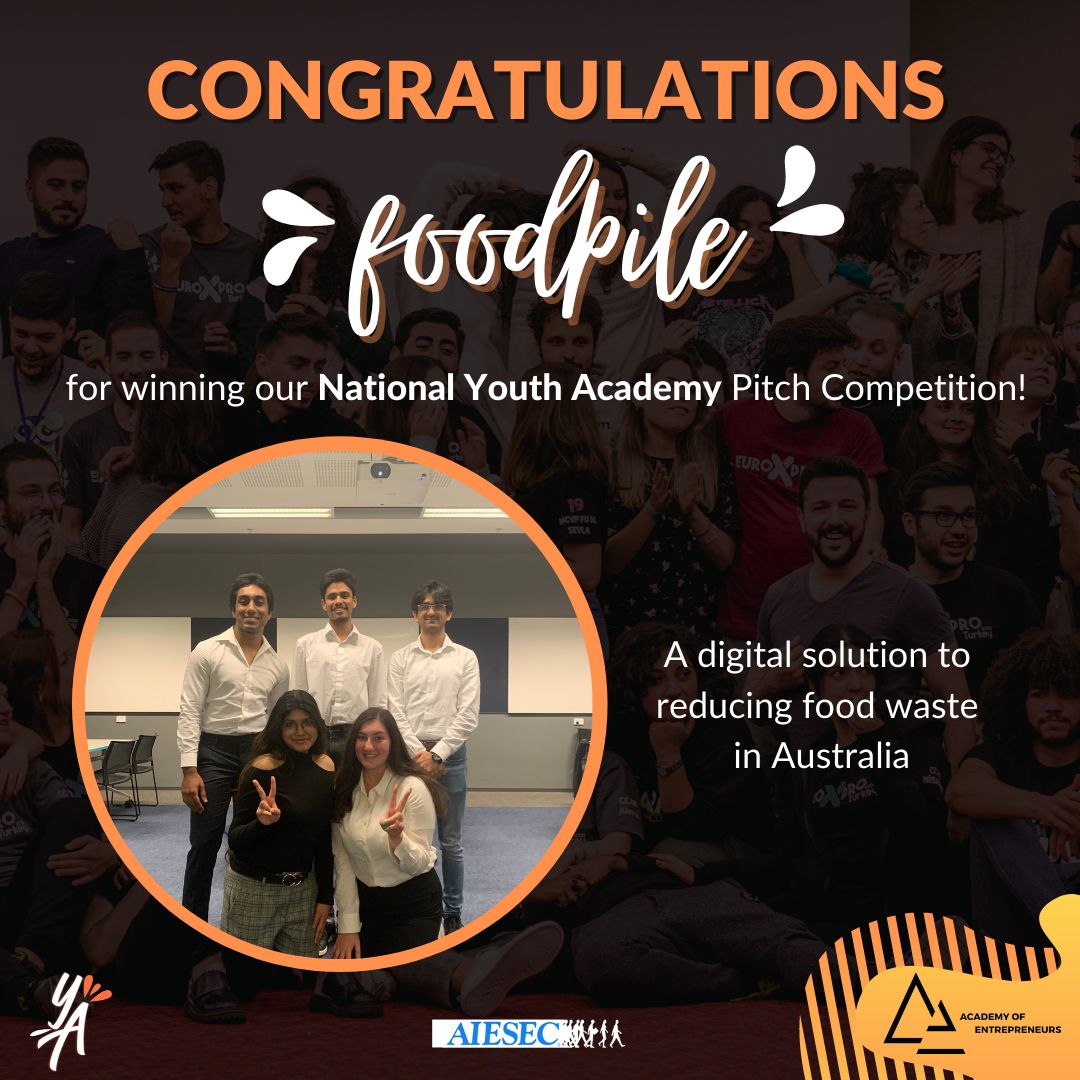
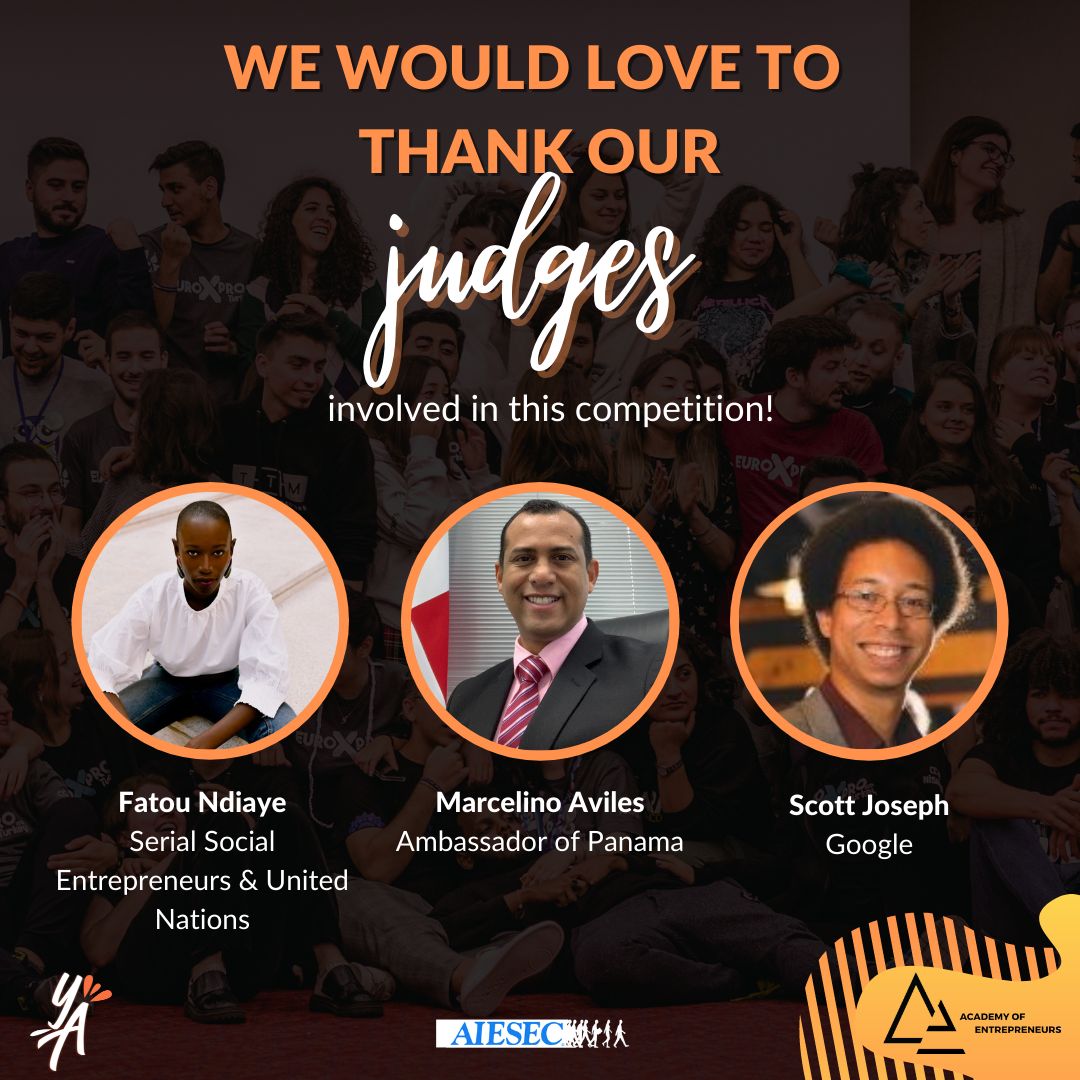
National Prize winner, judged by Google, the UN and a national ambassador.
Winning the AIESEC YLX Nationals confirmed the solution resonated with a wide audience. The clearest lesson was the value of considering business outcomes inside the product design process, rather than bolting a pitch onto a finished design.
Given more time, I would have run mid-stage user testing to make the interactions more engaging and tailored. The project is a study in balancing the speed of a pitch with the rigour of the design process, a trade-off I carry into every project since.
Learnings & impact
What the work changed about how I build.
- Business outcomes belong in the design process. Designing the product and the pitch together, not in sequence, is what won it.
- Make the invisible visible. People overbuy because they cannot see their pantry. The product's real job was to show it back to them.
- Design for one real person. Alex Kinley kept every feature decision honest, and cut the forty ideas down to three.
- Speed and rigour trade off. A pitch deadline is not an excuse to skip mid-stage testing, and next time it would not.